Showing posts with label freedom. Show all posts

Sunday, July 14, 2024

Aga Khan Palace & Gandhi’s Imprisonment: Part I - Non/Digital


Yesterday I visited the Aga Khan Palace in Pune, the place where M K Gandhi and his colleagues were kept after their early morning, surreptitious arrest by the British in 1942. The British apparently tried to keep the arrests under the wrap and spread a rumour that Mr. Gandhi went abroad. However, people soon found out where he was and anger spilled on the streets. The ‘Quit India’ movement, which was the primary reason for the arrests, gained even more momentum inspite of more arrests and brutal use of the police force by the colonisers. Gandhi and his colleagues were finally released in 1944, after about 21 months of imprisonment and the deaths of Mahadev Desai (the personal secretary of Mr. Gandhi) and Kasturba Gandhi.

There is a lot to that story, but much before that, I was greeted by a message pasted on the Ticket booths windows at the Aga Khan Palace. It read 'Only online ticket' in English, Hindi and Marathi. 


I noticed visitors standing and busy with their phones. Two men were sitting inside one of the ticket booths; and a guard at the entrance, who checked the ticket before one could enter the space.

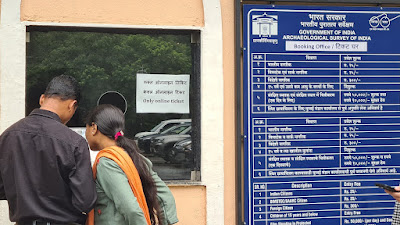
I do not use digital payment apps or credit cards. So, I asked the two men inside the ticket booth if I could buy tickets with real money. The cost was just 20 Rupees per ticket. I was told that there is no other way except a digital transaction which includes Net-banking as well. While I would still have preferred paying the cash, I decided to use that to end the issue through Net banking and went through the Archaeological Survey of India’s (ASI) ticketing app. After filling in a variety of information and avoiding the non-mandatory fields I finally pressed the button to pay.


A few moments of processing later a message appeared:

“System Upgrade in Progress to Enhance Your Banking Experience. Service Unavailable until Saturday, 13th July, 4.30 PM.

We Apologize for the Inconvenience.”


I find it difficult to fathom the reasons that made ASI decide to go in for an online payment system. Is it not obvious that such a system prevents an entire Indian population who still do not have smart phones? And also those who may have a smart phone but may not always have an internet connection for various reasons, including its cost? As per the information issued by the I&B Ministry in 2022, only 600 million Indians (out of the 1.4 billion) owned a smart phone.  I could not find the data for 2024, but even we assume there are 700 or even 800 million smart phone users, it leaves out at the very least about 600 million Indian citizens.


 That basically amounts to putting a needless barrier for some. In other words it turns into a needless system of segregation and discrimination, even if that may not have been the intention.

Parvez

(Photo credit: Parvez)

All rights for the Text and Photos are reserved with the author. For permission, please write to the author. 

Sharing of the 'complete, un-edited write-up' is permitted only for educational and - or non-commercial purposes, with due credits to the author.   

Tuesday, November 19, 2013

Of freedom and capitivity

What does a zoo mean to an animal? Is it a place where life is safe and easy? Or a situation of imposed captivity and a loss of freedom?

Animals are free to roam across the land in the wild. They can do whatever they want – the essence of freedom. That also means fending for oneself. The search for food, water and shelter therefore becomes essential for a free animal. It also means facing the vagaries of nature and avoiding the claws of predators (that range from other animals to the most dreadful one – the man).

Man, the predator, also runs zoological parks (aka zoo). Initially Zoos were a display of 'living objects of wonder'.  Later, for moral reasons, their existence was justified as a place that helps in studying and breeding animals. Presently they don an even more benevolent mantle to justify their existence as a place to 'preserve' other species. However, 'What or who is responsible for bringing certain species to the brink of extinction (that now justifies their capture, confinement and even forced mating in zoos)', brings us back to square one. We devastate habitats, interfere with others freedom and then capture and put them in cages (or other  defined areas) to prevent them from getting extinct. Unfortunately, even this act of valor reeks of greed. We save whatever little is left of the others because they may be or actually are of some use to us, somehow.

I must say though that animals are mostly treated 'reasonably' well in zoos nowadays. They get food, water (implying that they don't have to hunt or search and risk their life) and shelter. Even their health is taken care of by the veterinary doctors at the zoo. Heaters and coolers are provided in the cages, as per the season to maintain a comfortable temperature, for those considered upper caste (read: more important). It is a reasonably luxurious life that many third world citizens may even be envious of and may never achieve in their lifetime. Still, would an animal want to live in a zoo? What will we choose, luxury or freedom, if we are in their place? Whatever the answer, almost all of us are anyway living a caged existence. The only difference between us and the animals is that they realize they are caged but, we mostly do not.

We see the animals confined within their cages and infer that we are free because we are ‘outside’ the cage. But, if someone watches us from beyond the earth, would they not find us equally confined by actual boundaries, fences, gates and grills beside the abstract and conceptual notions of race, religion, class etc. etc.? What makes it difficult for us to understand this captivity is the paradox of finding comfort (that comes from familiarity and charted paths) in a confined space. The sense of comfort and ease that we get from the social structures (both physical and conceptual) is exactly the same that is used to justify the confinement of animals, especially those that are born in a zoo or captivity. For example, what will we do to quench thirst within the confines of say, our home or school or workplace? The ease of knowing these space guides us to the nearest refrigerator, water cooler or a tap, without thinking twice. We don't have to worry about where it comes from and how it reaches the tap or it's drink-worthiness, because that is the 'given comfort' - a part of the structural confinement (both cognitive and physical) by a social system, that we accept in lieu of our freedom.

In contrast, a wanderer in a forest will have to think, deduce and figure out where water is most likely to be and then work his / her way to the source. The risk of failure being way bigger, the wanderer however has his freedom to rejoice and explore life. 

An animal born in a zoo can not know freedom, unless it steps out and manages to escape the brutality of the civilized structures, the numerous cages and the people who justify and control it.

(This is the unedited piece that was written originally for my weekly column 'Sacred Bull' in Financial Chronicle Newspaper.  Edited version was published on Oct 17, 2013)

(All material on this blog is copyrighted! Sharing of complete articles or their links, without editing, and with due credit, is allowed for non-commercial purposes only. For publication or any other use, please contact the author.)